
Nik Bhatia
@timeaboristic
Nik is an adjunct professor at USC Marshall School of Business, where he teaches separate courses on fixed income and bitcoin. He is author of the #1 bestseller Layered Money. Previously, Nik worked at a large institutional asset manager trading US Treasuries and is both a CFA and CMT charterholder.
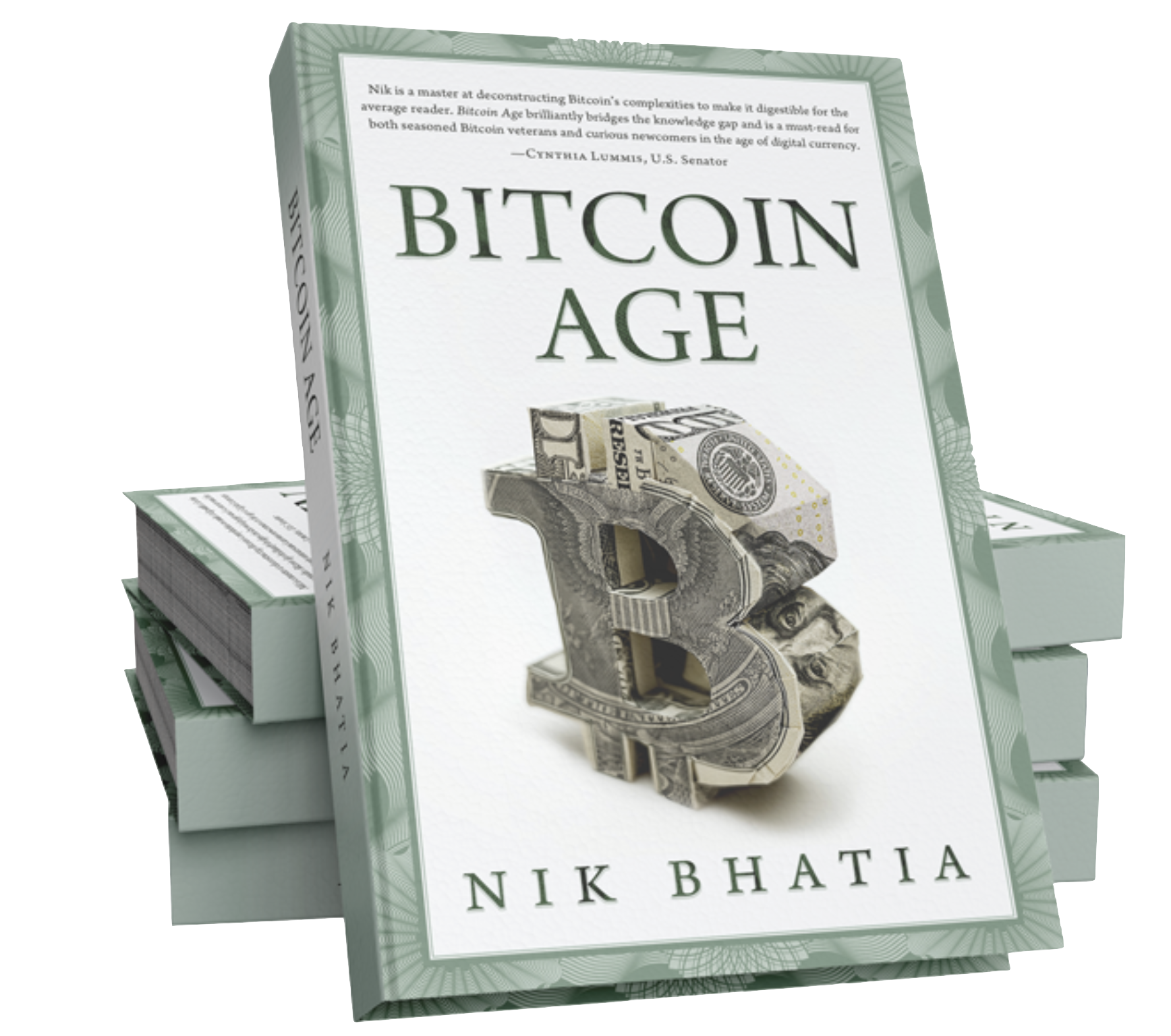
About Bitcoin Age
In Bitcoin Age, Nik Bhatia takes readers on a journey through the intersection of monetary history and technological innovation. The book examines how Bitcoin is reshaping the global financial landscape, from its origins as a cryptographic experiment to its emergence as a legitimate monetary instrument. Bhatia draws on his experience as a fixed-income trader and academic to provide a rigorous yet accessible analysis of Bitcoin's role in the evolving monetary order. The book covers the mechanics of Bitcoin's monetary policy, its relationship to traditional financial markets, and its potential to transform how we think about money, value, and economic sovereignty in the digital age.
In Bitcoin Age, Nik explores:
Origins of Money
Bhatia's analysis traces the evolution of monetary systems from ancient civilizations through the gold standard to the modern fiat era, setting the stage for Bitcoin's emergence.
Evolution of Digital Currencies
How Bitcoin has already achieved legitimacy as a global reserve currency and will continue to drive corporations like MicroStrategy into a state of balance sheet denomination duality.
Mechanics of Financial Systems
Readers will come away with an understanding of the mechanics of our financial system, why the dollar is deeply entrenched despite its state of disrepair, and how digital currencies will interact in our new monetary future.
Monetary & Cryptography Sciences
Bhatia illustrates how the invention of Bitcoin created a seismic shift in money and merged the monetary and cryptography sciences for the first time in history.